Simone Belloni Pasquinelli, born in La Spezia in 1966, is a passionate spearfishing journalist and a deep connoisseur of competitive spearfishing, a world in which he also made a curious appearance. For twenty years he wrote for the online magazine Apnea Magazine, a benchmark for competitive and recreational spearfishing alike.
Hi Simone! Finally! It wasn’t easy to get this interview done—what a pleasure. Do you have anything you’d like to say before we start with the questions?
I don’t dodge Intro or Indro, and here I am—arms hanging, weapons sheathed. But I can’t really see myself as a figure of spearfishing journalism, ontologically speaking. I don’t like being interviewed or appearing anywhere. I’m a de-generate. Interviews bore me as a genre. There’s nothing creative or uplifting about them. It’s a bumpy road and you risk bumps. But go ahead—commit this foul. Let’s do this in every sense. But let it remain between you and me.
The parallel you drew with Montanelli could even have an acronymic logic: R.S.I. = Italian Underwater Resilience.
Thank you! So, Simone, how did you first get into spearfishing? And how did it eventually intertwine with journalism?
Out of passion. They seemed like heroic acts to me. I was challenging the unknown—an uneven match. My parents had a sporting goods store and they stocked diving equipment. The Mares representative was the Marò, and he came regularly for the seasonal orders. It was the late ’60s, early ’70s, and spearfishing was still seen as fascinating, pioneering.
I’ll tell you an anecdote that seems laughable today: I used to buy my school notebooks at Upim because some packs had a spearfishing scene printed on the covers. In my bedroom a poster of Massimo Scarpati with a harpooned shark reigned supreme. Epic stuff.
As you can see from these first lines (and I’m telling this to you, only to you), the signs that I would eventually dive with a speargun were all there. And that’s what happened. At first with my uncle, then with friends here and there, often strangers united temporarily by the same hunger.
I’ve never been a great fisherman. I’ve always caught my fish, but I never fully put myself on the line. And if you really want to reach the next level, that’s something you cannot allow. I was far more attached to hunting. Still, I went to the sea regularly throughout the season.
I loved reading about the feats of competitive spearfishers. Mondo Sommerso was excellence—you really felt alive, part of the circle. Unforgettable chronicles by illustrious pens like Capodarte, Ripa, etc.
That invisible thread later intertwined with Apnea Magazine, the e-zine for which I became a contributor and eventually a full-fledged writer.
Whoever writes is a writer—period. If they pay you and you enroll in the professional register, then you’re also a journalist (from “title”, etymologically speaking). I never took a cent. I didn’t want to. I would’ve lost every spark. I don’t like forced things (I’m struggling even now—when you write following a script, you turn into a diarist).
I write out of motion, not manners—and passion is my engine. I wanted to write under a pseudonym but the Editor-in-Chief wouldn’t have liked it, so I playfully bluffed and passed myself off as “Simone Belloni”. There are several Simone Bellonis in Italy, so it worked.
Contrary to what many thought, I knew the competitive world extremely well, even without attending much. All its small virtues and huge flaws.
I promised myself to stay away physically, but inside with the pen. I didn’t even attend Apnea Magazine gatherings.
One day Giorgio Volpe told me to show up because readers and collaborators thought I didn’t exist and that he was the one writing under a false name. It was pointless—and harmful—to face endless debates, embarrassing speeches, and people you’d eventually have to criticize.
Let me be clear: I’ve also met wonderful people in the field, with whom I’ve built good relationships, even friendships. But they’re rare cases.
Most are real gossips, climbers, egocentrics, masters of distortion—and some even informers. Pure self-glorifiers (of what, exactly? You’re first in the most hidden sport of nothingness?).
And let’s not talk about the higher-ups: a political puppet-show. People who never grew up, lost children of humanity, thinking only of their little LEGO-made garden. They live in a pedestrian paradise of subjugation. They don’t care about competitive spearfishing. They even said so publicly! (I knew I shouldn’t have agreed to this interview, damn it!).
To wrap up: look at the conflict of interest involving the National Team’s technical director—enough said.
The only thing I regret about quitting is not interviewing José Amengual. I was already in touch.
Who is the most successful competitor in history? Or better, give us your top three.
Ah, so we’re getting serious!
Finished with Amengual—and back to Amengual. In terms of victories in the field, he is unrivaled. And also number one as a person. I spoke to him a couple of times: at Eudi and at a European Cup trial. He looks like a golfer.
In second place I’d put Carbonell, and third Scarpati.
But competitive spearfishing isn’t just about numbers. There are time periods, nuances, proportions. In this special ranking I’d put Massimo Scarpati first: in 9 years of activity, he won 5 Italian titles, 1 European Championship, and 1 World Championship of spearfishing. Untouchable.
Just as untouchable was Mazzarri in the late ’80s and early ’90s.
Spain’s great advantage is geography: they have both Oceanic and Mediterranean waters. This is a huge asset for training and producing high-level athletes. Their youth system grows across a wide spectrum.
Today, in my opinion, the number one in the world is Oscar Cervantes, unsurprisingly another Spaniard.
Which past competition thrilled you the most, and why? And which present-day competition?
I think the 1976 Italian Championships were the competition par excellence. The Egadi Islands: five days, with qualifiers, semifinals, and finals. Unbelievable! In such a format, only the most prepared, tactically sharp, physically strong, and skilled athlete emerges. Unique and unmatched in difficulty and pathos.
Winning a one-day competition is, to me, half a victory.
Another extremely tough and fascinating event was the 1975 three-day Championship under a mistral so strong that fishing boats couldn’t go out. It took place in Santa Teresa di Gallura.
Also wonderful: Palau 1985.
Outside Italy, I’d say the 1992 World Championship in Porto Cristo: very deep and constant-depth dives, borderline weather conditions. What a show!
As for current competitions, I stopped following them in 2019. Some friends still update me, send photos, tell me stories. I listen only out of affection. There’s tenderness in their attempts to waken my mummified curiosity. I feel it.
But these are no longer real competitions. In a proper event, almost everyone should have a chance—out of principle, because they pay, because they have the technical skills to compete.
Instead, now if you don’t go down to 40 meters with 20 kg of lead that someone retrieves for you, you’re out. Regulations tailor-made—and, dare I say it (I won’t say it, I’ll write it): embarrassing!! Nothing educational or formative.
Of the recent photos I’ve received, the only impressive one was the 10 white seabream (9 valid) from Praiola, first day of the 2023 Absolute Championships. Now that is real stuff. Delightful!
A very good Absolute I recall among the latest was Castelsardo 2016. Plenty of excellent fish. A competition open to everyone.
P.S. There were two promising youngsters recently: Gentilino and Konjedic. What happened to them?
Three-prong tips: yes or no? And if yes, why, and with what setup do you prefer them?
It’s like asking: “fio” yes or “fio” no? Of course fi! Absolutely three-prong. Or better: a system.
There are two unmatched three-prongs on the market: the K4 and K6 by Riolo Sport. Unbeatable in quality and design.
The spearfishing market is small and limiting. For a large company, producing marginal items like prongs is an unnecessary cost, so they reduce production expenses with poor materials.
The prong is one of those accessories that suffers greatly from this logic. We see indecent objects sold today—merely a shape pretending to be a prong. Some induce disgust.
Riolo has maintained its high standards. Because he uses them himself—and he’s meticulous.
The great advantage of these prongs, underestimated by most, is that you can pair them with dedicated shafts—Tahitians threaded so that the point passes through the plastic body, acting as a stabilizing fin, strengthening the whole.
You can also use the Extreme system, with 6 mm shafts. I’ve used it since 2002. Spectacular!
A small downside: the tapered tip can bend if it hits rock. So be careful when shooting near rocks or inside tight caves.
My favorite gun is a 55 cm with an Extreme shaft slightly longer than standard (85 cm) and a K4. Great for aiming when shooting in drop or ambush. Progressive bands: Sigal reactive 16 mm or similar Cressi.
Tell us about your experience in competition.
Here too I risk producing a paradox I don’t feel emotionally. Competitions have always fascinated me—virtually. Stories thrill me, events carry me away, technical feats seduce me.
But going into the water to compete? That never appealed to me. I got my license in 1994 and did some club competitions. Didn’t care at all. Though I’m naturally competitive… I don’t know.
One thing I know is that preparing a competition area bores me.
In 1996 I assisted Luigi Andreani in the qualifying trials. I think I helped him prepare the field once—maybe not even. He qualified anyway.
Later, in 2002, thanks to Riolo, I went to Follonica for the Italian Team Championship. With us was Giuseppe Lo Baido. Two champions with opposite styles: the first fast, intuitive, lethal; the second pragmatic, practical, essential.
We scouted the area two days. Nicola had some markers from previous competitions but we didn’t find much fish. Shallow seabeds, lots of seagrass, occasional rocks with wrasse, white seabream, conger.
Curiosity: in 5 meters of water those two found a 4/5 kg grouper. Not valid, but probably the only one in the gulf. It was accompanied by a wrasse Nicola estimated at 300 g. Minimum weight. I thought it was much less. (We’ll get back to wrasse later.)
Preparation was clear: Nicola checked his marks, Lo Baido searched around. Sometimes long glides looking for a jolly spot. We didn’t find one.
At the start we decided to shadow the home team—Fabio Della Spora and company. They headed south. Damn! The whole competition uphill swimming toward our northern marks, fishing along the way.
At some point Riolo told me to hand him the “who-knows” from the bag. I found an old miniministen with a 6 mm shaft and K4.
“When things get complicated, this solves everything,” he said, coming up with a conger shot in an impossible hole. That gun became part of my equipment from then on.
We eventually completed our planned route and weighed 4 congers and 11 other fish—including white seabream, corvina, and wrasse—finishing behind the home team winners.
P.S. The wrasse estimated at 300 g weighed 301 g—I remember because I stared from 40 cm during the weighing. A great experience.
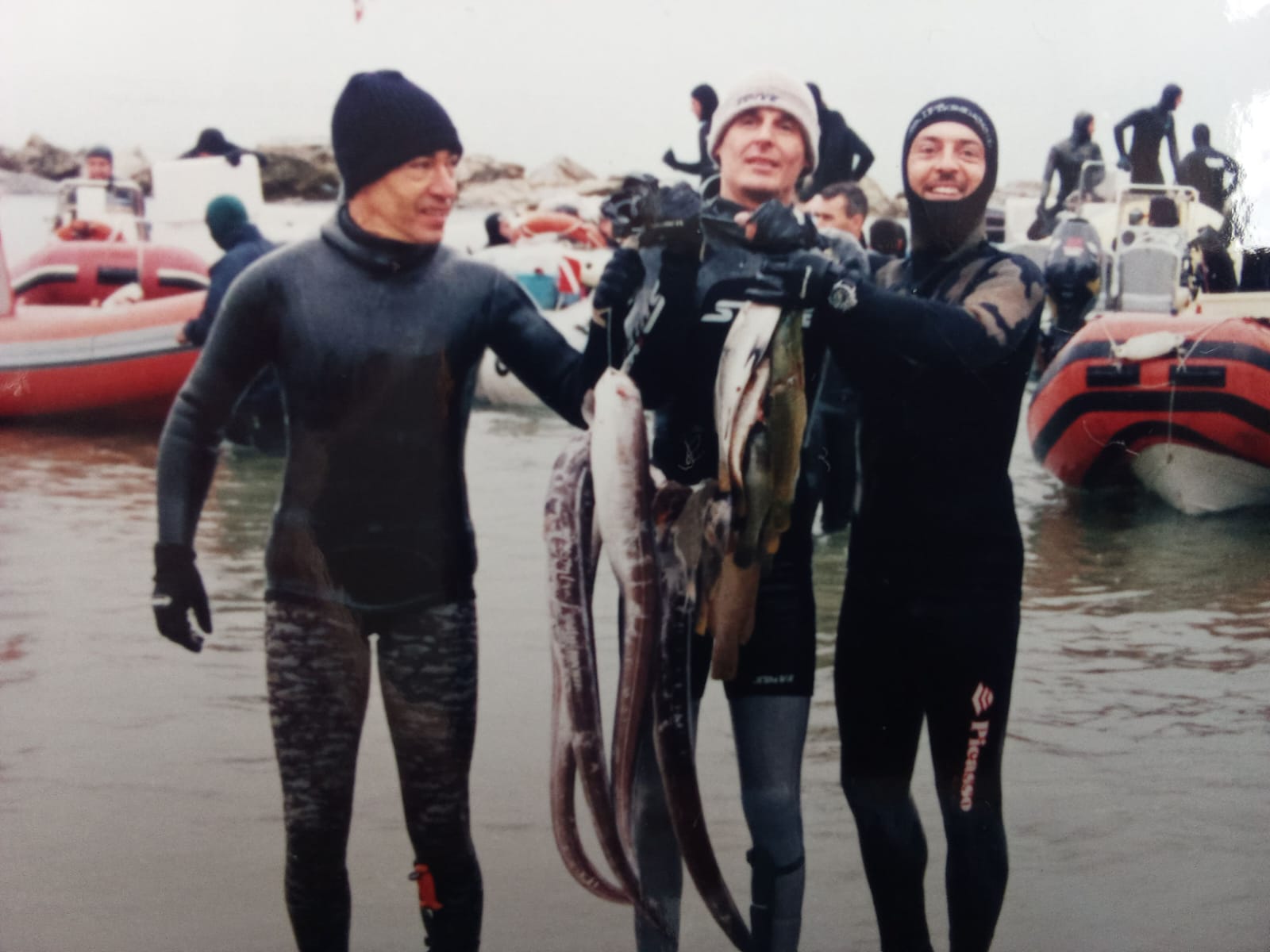
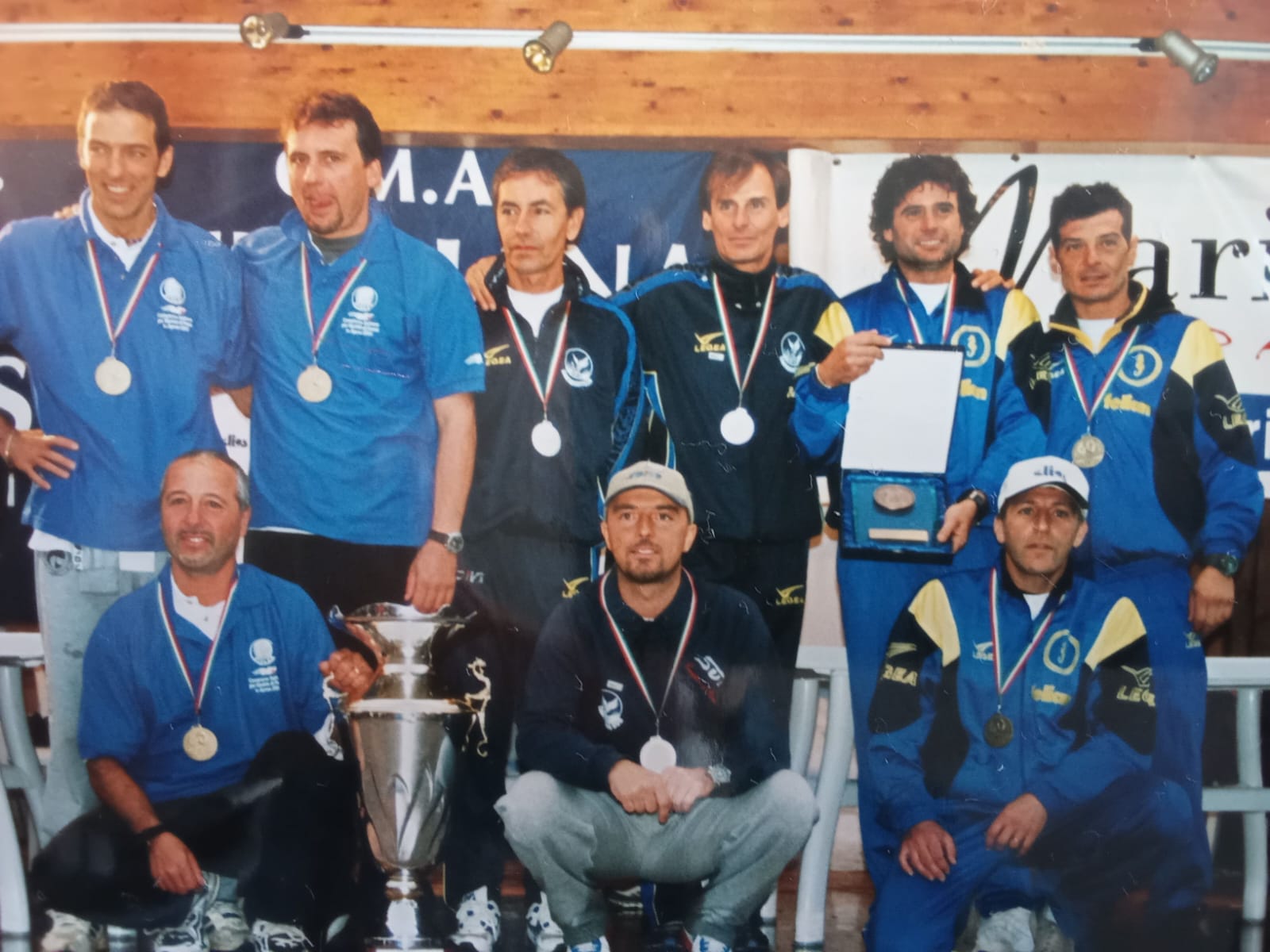
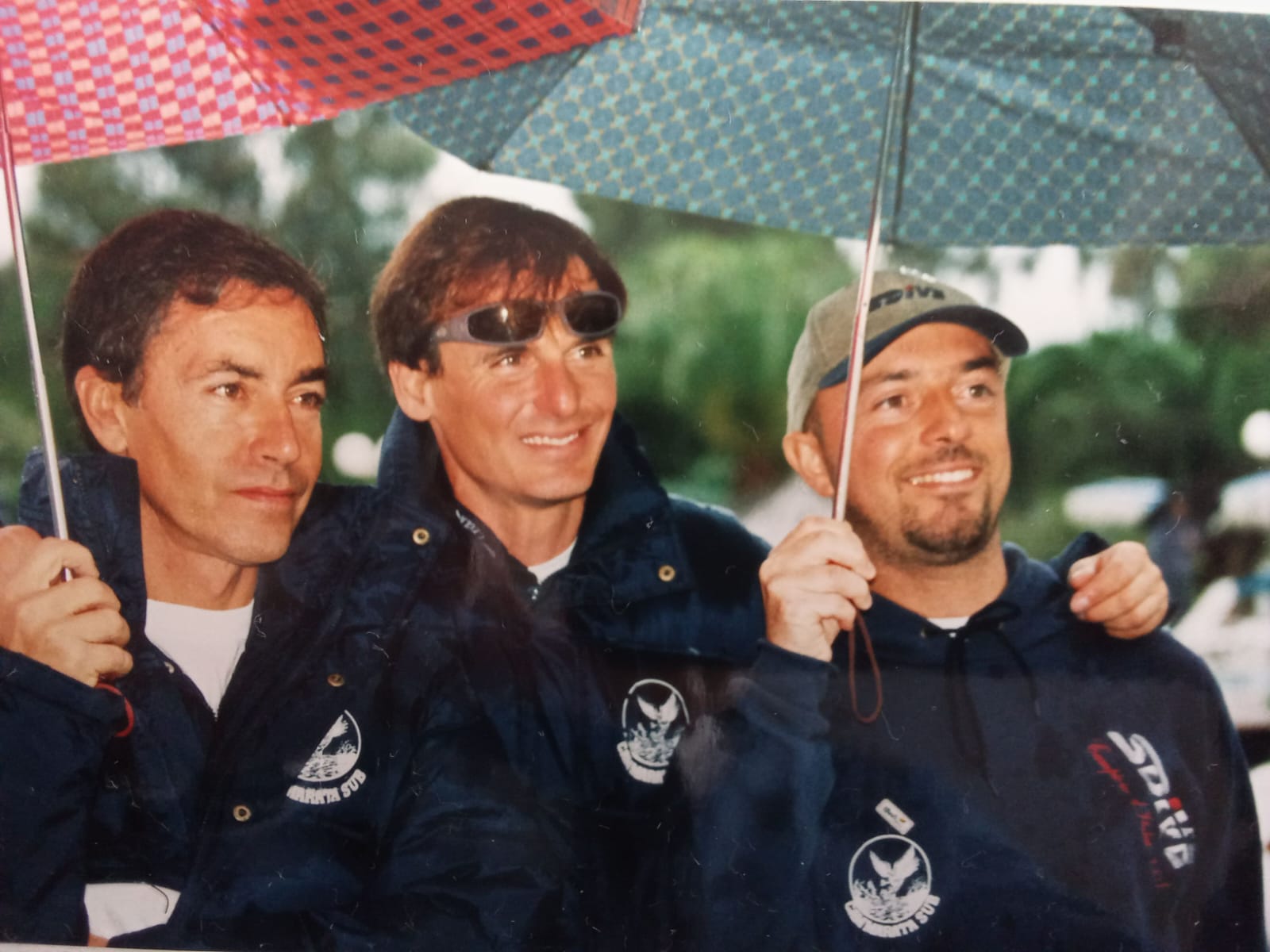
Podium, Italian Team Championship, Follonica 2002.
An undoubtedly great experience! What made you distance yourself from spearfishing and journalism?
Let’s go in order.
I still fish occasionally, but only in summer and not much. Time passes, things change, priorities shift. “Time becomes a tyrant”—a painfully true saying.
As for journalism, I drifted away mainly due to lack of stimulation and because it has turned into something funerary.
What differences do you see between past and present competitive spearfishing?
The most obvious is that champions of the past had overwhelming charisma. They were intimidating just to imagine.
Today we have a lineup of supposed “little champions”—all with the same face, the same smile, which to me has the charm of a fly on a table.
Also, there used to be a lot more fish, so you improved quickly, and the level was high. Maybe the same people won often—but that’s because they were extraordinary.
Now tell me: where is the extraordinary athlete today?
Has spearfishing lost some of its aura—mystery, fascination, secrets passed only to selected few—now that digital sharing and technology are available to everyone?
Competition is dead (I swear I saw the funeral and burial. I was there. I remember the cypresses).
Recreational spearfishing limps along.
The aura—your kind of aura—resigned years ago.
Now everything is out there. Anyone with some breath and decent technique can catch the fish of a lifetime. The tech revolution changed everything, for better and worse.
Limits should be set. But I won’t get into that. I withdraw—like the aura.
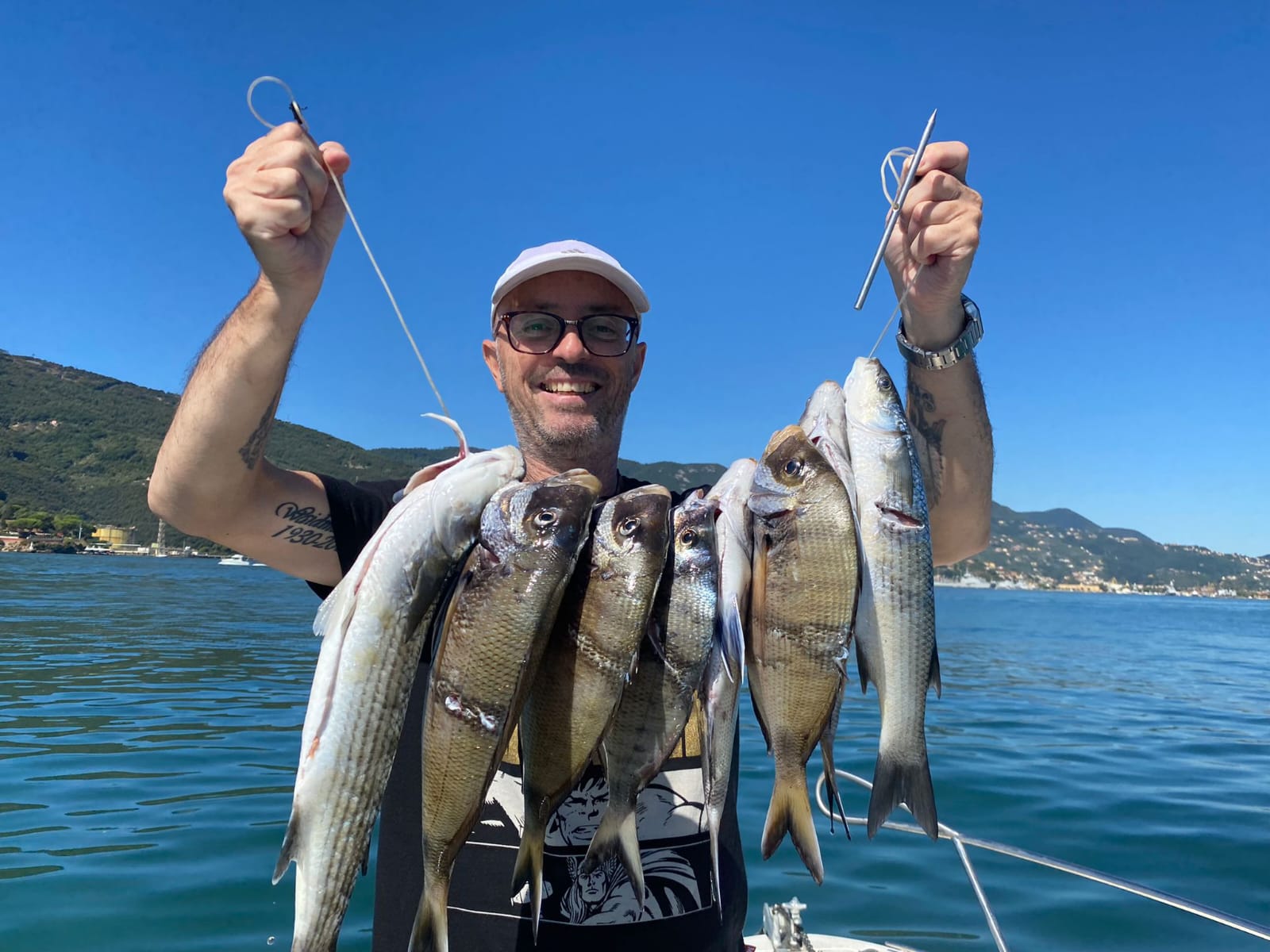
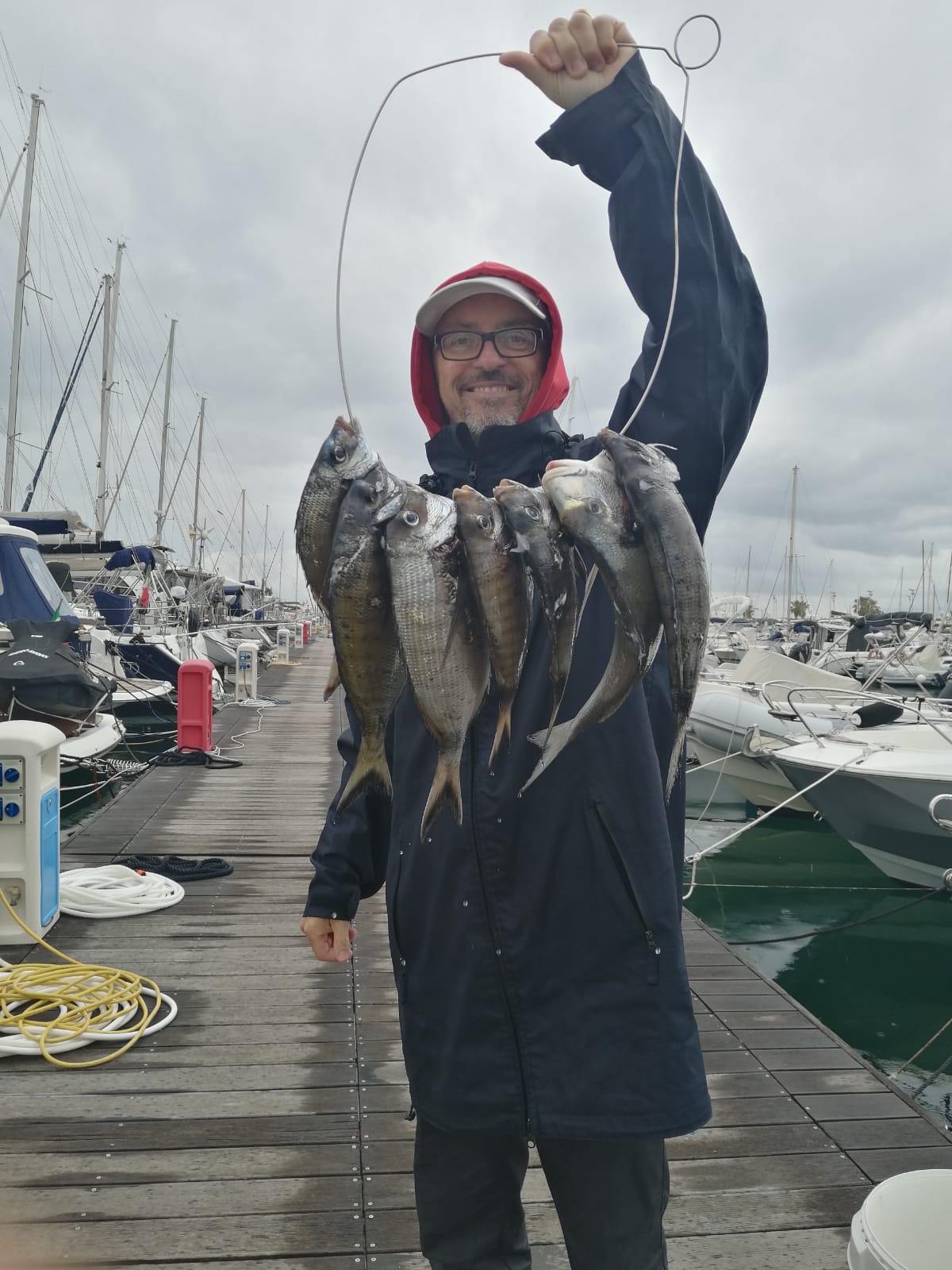
Simone Belloni Pasquinelli with a stringer of sparids.
There’s been talk of little meritocracy in the National Team recently, yet results seem to justify the choices of the CT. What do you think?
Really?
“Coito ergo sum!”
Is there anything in the world that isn’t a point of view?
Anyway, I stopped following after 2019. Until then there wasn’t much to celebrate.
Oh yes—wait—I remember now: we won a World Championship in Arbatax? Around 2021? Yes, the last World Championship won by Italy at home. And it’s always the last. It might be the last. It should be the last.
When they say: “Italy won the last World Championship…”—stop there: the last, indeed.
Do you have any suggestions to revive competitive spearfishing in Italy?
“If I had them, I forgot them.”
A pagan rite? A memorial mass? A Tibetan ritual for reincarnation?
That’s what comes to mind.
But why involve so much religion? Is it even worth it?
Let’s talk a bit about you: what’s your favorite technique and where do you usually fish?
I fish in La Spezia. Very little lately.
80% of my fishing is cave hunting, 20% ambush. It used to be the opposite because I often did ambush with rough sea along the Palmaria or Tino cliffs. Then the marine park was established and everything changed.
I almost never do aspetto because it bores me. I stay there a few seconds, then spot a hole in the distance and go check it. I like dynamic fishing.
For ambush I use an 80 cm carbon barrel (26 mm) or, depending on visibility, a classic 100 cm aluminum gun.
I rarely use a 90 cm gun, strangely enough.
Closed muzzle, 6 mm double-flopper shafts, 16 mm soft bands.
My guns aren’t powerful but they’re lasers. If I miss, it’s my fault (dura lex sed lex).
Do you notice differences between old printed magazines and today’s ones? And what do you think of social-media-based content?
Of course there’s a difference! That was the past—this is the afterlife.
My God, they are unreadable. A mess of advertorials.
I’ve read a couple recently just to check—and yes, unreadable. At least for me.
I never got much from Laudati, who nonetheless showed some passion and skill. There was some balance.
Now articles are signed by unknown figures who might become readable, but continue to do their homework—writing the latest brochure. They’re pamphlets.
How can you compare them to Mondo Sommerso, the early Pesca Sub? With all the limits of the discipline, of course.
Maybe I’m nostalgic—but I’m not stupid.
Think of Umberto Cioffi’s itineraries, Capodarte’s chronicles, Sergio Scuderi. Then Guido Pfeiffer, Flory Calò, Gianni Risso, Domenico Drago, Stefano Navarrini.
Should I go on?
No.
If today’s writers didn’t sign their pieces, at least they’d save face. But they put their faces too. Front and center.
I don’t blame them—they’re almost endearing.
The readers are worse off. I don’t even understand why they read me, imagine the rest.
Let’s face it: we’re talking about humble spearfishing. We’re forgotten before we’re even remembered.
You write an article and sign it as Simone (well, not Simone, that’s me—that would be self-indulgent).
I once read on PescaSub an article by an Emiliano (don’t remember the surname): small fry, staying on topic.
But again—not even Thomas Mann teaches you much; imagine them…
P.S. Are we done with this chat? I’m a bit tired.
A hug, Carletto—and I truly wish you good luck… in life.
https://www.instagram.com/sea.experience.sardinia